
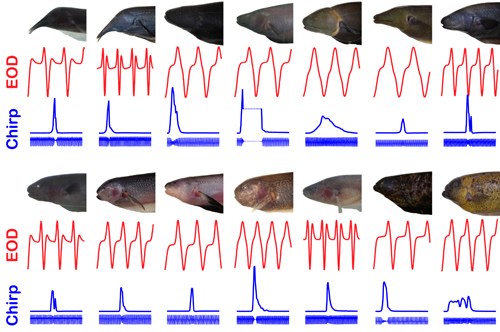
Evolution of EODs and Chirps. Our laboratory studies two different types of communication signals in electric fish: the electric organ discharge (EOD), and modulations of the EOD known as chirps (click here for background information on chirping). We study EODs and chirping in different species of ghost knifefishes (Apteronotidae), the largest family of South American electric fishes. EOD frequency ranges from ~500 Hz to 2000 Hz in these fish (click here for background information on species differences in EOD frequency). The waveform of the EOD (how the voltage changes during a single discharge) also varies across species. Species differences in EOD frequency and waveform may allow fish to use the EOD to identify the species of other fish.
Although EOD frequency and waveform have been studied in many species of electric fish, relatively little is known about how chirping varies across species. Because chirps are produced when fish encounter rivals or potential mates, they are likely to be important social signals. We study both inter- and intra-specific diversity in the structure and function of chirps to understand how these communication signals evolve.
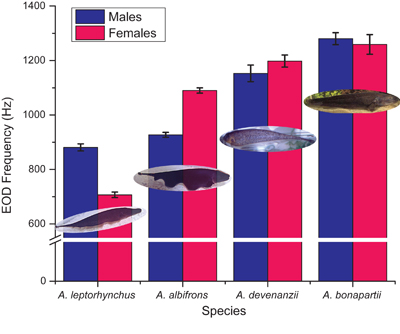
Evolution of Sex Differences in EODs. Different species of electric fish vary in the degree of sexually dimorphism of their electrocommunication signals. For example, EOD frequency is sexually dimorphic in both brown ghost and black ghost knifefish (A. leptorhynchus and A. albifrons), but the sex difference is in opposite directions in the two species (Dunlap et al. 1998; Kolodziejski, et al. 2005). In A. leptorhynchus, male EODs are higher in frequency than those of females, whereas in at least some populations of A. albifrons, males EODs are lower in frequency than those of females. Other apteronotid species, including marble-leaf knifefish (Adontosternarchus devenanzii) and dragon knifefish (Apteronotus bonapartii) produce EODs that do not differ between the sexes (Zhou and Smith 2006; Ho, et al. 2010). Examples like this, in which both the magnitude and the direction of sex differences in behavior vary across closely related species, are relatively rare and provide an opportunity to study how sex differences evolve. We are also studying variation in the sexual dimorphism of EODs across different populations of the same species. For example, in A. albifrons populations from Colombia, EOD frequency differs substantially between males and females, and males and females can be distinguished reliably based on the frequency of their EODs. In contrast, in A. albifrons populations from Brazil, EOD frequency is similar between the sexes (Ho et al. 2013).
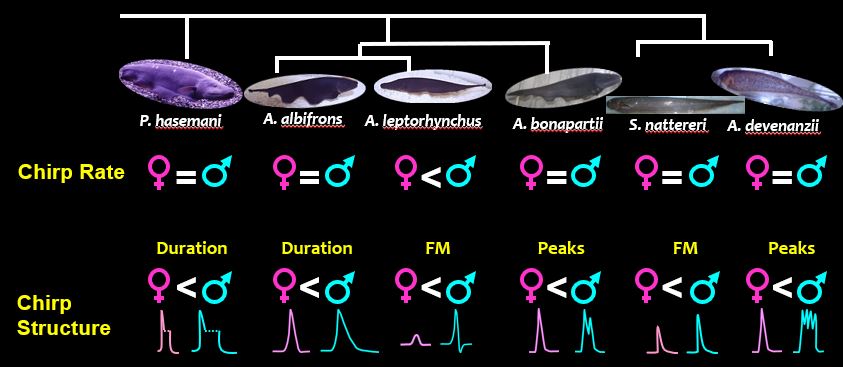
Evolution of Sex Differences in Chirping. Sex differences in chirping also vary across species. In A. leptorhynchus, chirping is highly sexually dimorphic. Males chirp much more than females and produce high-frequency chirps that females rarely produce. Chirping is also sexually dimorphic in other species that we have studied, but sex differences in the chirps of these species are more subtle. Unlike in A. leptorhynchus, the number of chirps produced in response to playbacks in these species does not differ significantly between sexes. Instead, males and females differ mainly in chirp structure. Male Sternarchogiton nattereri produce chirps with more frequency modulation than those of females (Ho et al. 2013). Chirps of male A. albifrons and Parapterontus hasemani are longer in duration than those of females (Kolodziejski et al. 2005; Petzold and Smith 2016). In A. devenanzii and A. bonapartii, males are more likely than females to produce “multi-peaked chirps” (Zhou and Smith 2006; Ho et al. 2010). A current focus of our research is to characterize sex differences in EOD frequency and chirping across many different apteronotid species to understand how sex differences in electrocommunication behavior evolved.
References
Dunlap, K.D., Thomas, P., and Zakon, H.H. 1998. Diversity of sexual dimorphism in electrocommunication signals and its androgen regulation in a genus of electric fish, Apteronotus. J. Comp. Physiol. A 183:77-86.
Ho, W.W., Fernandes, C.C., Alves-Gomes, J.A., and Smith, G.T. 2010. Sex differences in the electrocommunication signals of the electric fish Apteronotus bonapartii. Ethology 116:1050-1064.
Ho, W.W., Rack, J.M., and Smith, G.T. 2013. Divergence in androgen sensitivity contributes to population differences in sexual dimorphism of electrocommunication behavior. Horm. Behav. 63:49-53.
Kolodziejski, J.A., Nelson, B.S., and Smith, G.T. 2005. Sex and species differences in neuromodulatory input to a premotor nucleus: a comparative study of substance P and communication behavior in weakly electric fish. J. Neurobiol. 62:299-315.
Turner, C.R., Derylo, M., de Santana, C.D., Alves-Gomes, J.A., and Smith, G.T. 2007. Phylogenetic comparative analysis of electric communication signals in ghost knifefishes (Gymnotiformes: Apteronotidae). J. Exp. Biol. 210:4104-4122.
Zhou, M. and Smith, G.T. 2006. Structure and sexual dimorphism of the electrocommunication signals of the weakly electric fish, Adontosternarchus devenanzii. J. Exp. Biol. 209:4809-4818.
 Electric Fish Lab