
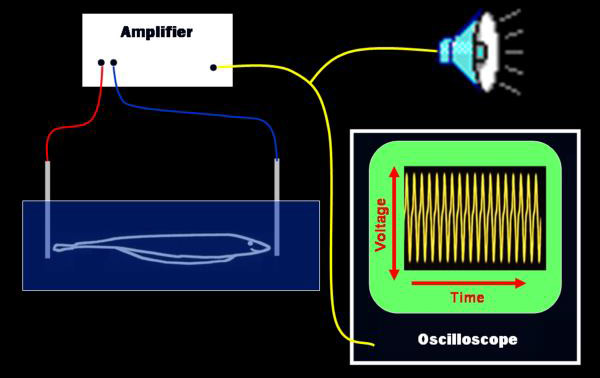
Recording EOD signals: The EODs of weakly electric fish can be recorded by placing two electrodes (bare wires or carbon rods) in the water with an electric fish (either next to the fish or at two ends a fish tank) and amplifying the voltage between those electrodes. The amplified signal can be connected to a speaker, which transduces the EOD into a sound, or to an oscilloscope or computer, which allows us to visualize, record, or measure the EOD.
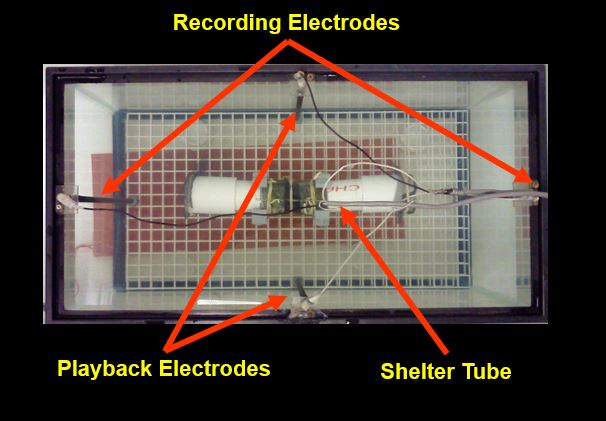
EOD Playbacks: We can also place two electrodes in a tank with the fish and play an artificial EOD signal through those electrodes. This can either be done with the fish swimming freely in the tank which allows us to record the behavior of the fish as it interacts with the playback electrodes, or with the fish confined to a shelter tube or hammock, which allow us to precisely measure the properties of the electric communication signals the fish produces in response to the playback. The responses of the fish to these playbacks are in many ways similar to their responses to conspecific fish. We use such experiments to characterize the function of electric communication signals. See the page on our research to learn more.
 Electric Fish Lab