
In electric fish that produce wave-type discharges, EODs are continuously emitted. Consequently, electric fish do not perceive each other’s EODs directly. Instead, the EOD of another fish is perceived via the interference of other fish’s EOD with the EOD of the receiving fish. When interacting EODs of two fish differ in frequency, those EODs interfere with each other to produce an amplitude modulation, or beat. The frequency of the beat (i.e., how fast the amplitude of the combined EODs increases and decreases) is equal to the difference between the frequencies of the two interacting EODs. If two nearby fish have similar EOD frequencies (as occurs when two fish of the same sex interact), the combined EOD has a low frequency (slow) beat, whereas if two fish have different EOD frequencies (as occurs when opposite-sex fish interact), the combined EOD has a faster beat. Thus, many species electric fish are able to distinguish the sex of another fish based on the beat frequency produced when their own EOD interferes with that of the other fish.
EODs also differ in waveform, which can convey information about the species identity of a fish (Kramer et al. 1981; Turner et al. 2007). We have shown that the EOD waveform of interacting fish is encoded in the shape/waveform of the EOD beat (Petzold et al. 2016).
When a fish chirps, it transiently increases the frequency of its EOD, and in many cases also reduces the amplitude of its EOD. This change in EOD frequency and amplitude, disrupts the regular beat pattern of two interfering EODs, and the receiver of the chirp perceives the chirp through this disruption of the beat. We are investigating how EOD frequency and waveform interact with chirp structure and the social environment of electric fish to influence the detection and discrimination of chirps.
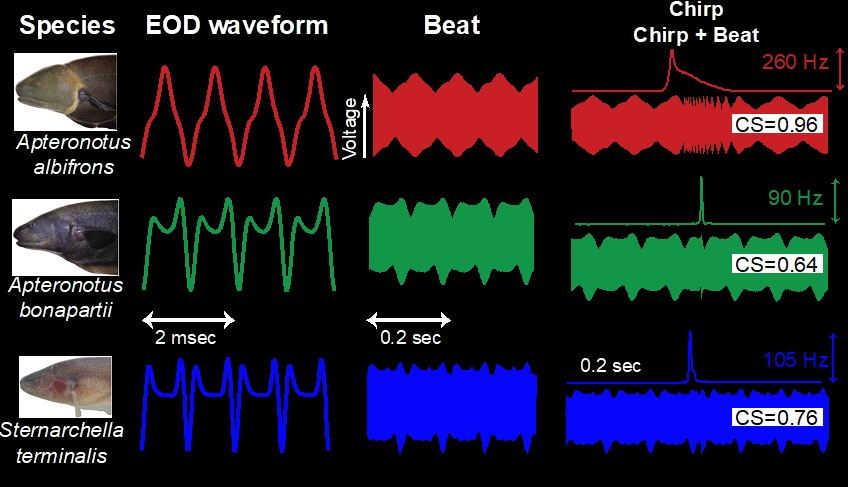
We are addressing several questions related to how species variation in EODs, chirp structure, and sociality influence the detection and discrimination of conspecific electrocommunication signals:
(1) How are species differences in EOD waveform encoded in the beat when EODs interact with each other. We have found that waveform complexity is encoded in beat waveform, with more complex EOD waveforms resulting in more complex beats, but that this relationship is non-linear (Petzold, et al. 2016).
(2) Does EOD waveform and frequency co-evolve with chirp structure to optimize the detectability and discriminability of chirps? We use computational methods to “synthesize” chirps of one species on the “beats” of other species to quantify how waveform and beat structure influence the conspicuousness of chirps.
(3) How does sociality influence the detection and discriminability of chirps? When more than two fish interact, the beat becomes more complex, which can make it more difficult for interacting fish to detect and discriminate conspecific chirps. Our hypothesis is that highly social species will have evolved particularly conspicuous chirps and/or sensory adaptations to enable them to perceive chirps in socially noisy backgrounds.
References
Kramer, B., Kirschbaum, F., and Markl, H. 1981. Species specificity of electric organ discharges in a sympatric group of gymotoid fish from Manaus (Amazonas). In Sensory Physiology of Aquatic Lower Vertebrates (eds. T. Szabo and G. Czeh), pp. 195-219. Budapest: Akademiai Kiado.
Petzold, J.A., Marsat, G., and Smith, G.T. 2016. Co-adaptation of electric organ discharges and chirps in South American ghost knifefishes (Apteronotidae). J. Physiol – Paris 110:200-215.
Turner, C.R., Derylo, M., de Santana, C.D., Alves-Gomes, J.A., and Smith, G.T. 2007. Phylogenetic comparative analysis of electric communication signals in ghost knifefishes (Gymnotiformes: Apteronotidae). J. Exp. Biol. 210:4104-4122.
 Electric Fish Lab