
Pulse-type vs. Wave-type EODs The EODs of weakly electric fish can be readily classified into one of two types: wave-type EODs and pulse-type EODs. Each species of electric fish emits only one of these two types of discharge. For species that produce wave-type EODs, the duration of each discharge of the electric organ is approximately equal to the time between discharges, and the timing between discharges is also relatively constant. Pulse-type EODs have durations that are much shorter than the time between discharges. Species that emit pulse-type EODs can often vary the timing between discharges.
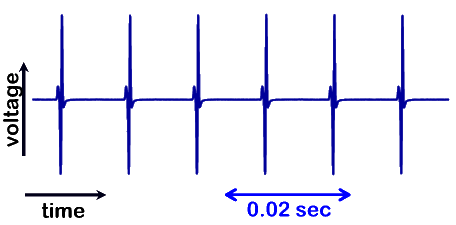
The tiger knifefish, Rhamphichthys marmoratus, produces a pulse-type EOD. The graph below shows the voltage difference between the head and the tail of the fish as a function of time. Each spike on the graph is an individual EOD pulse. Notice how the duration of each “pulse” of the EOD is much shorter than the time between pulses.

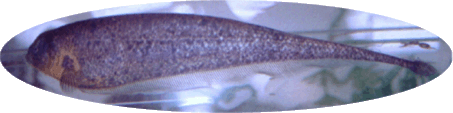
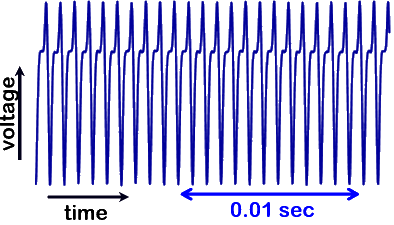
The gold-lined black knifefish, Sternopygus macrurus, produces a wave-type EOD. In the graph below, notice how the duration of each discharge is about the same as the time between each discharge. Notice how this “wave-type” EOD (when converted to a sound) is more “tonal” than the pulse-type EOD of Rhamphichthys.
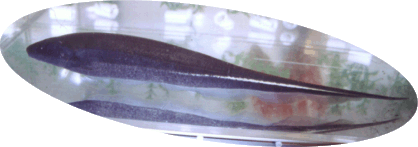
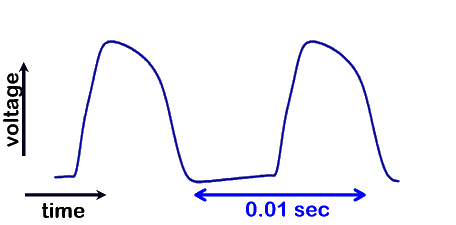
EOD frequency differs across species that produce wave-type EODs. The frequency of the EOD varies widely across different species of weakly electric fish. For example, Sternopygus macrurus has EOD frequencies of ~50-200 Hz. The EOD in the figure above is from a male S. macrurus and has a frequency of 86 Hz. In contrast, the transparent knifefish Eigenmannia virescens, shown below, has an intermediate EOD frequency (250-500 Hz).
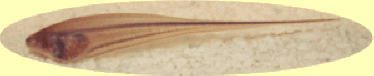
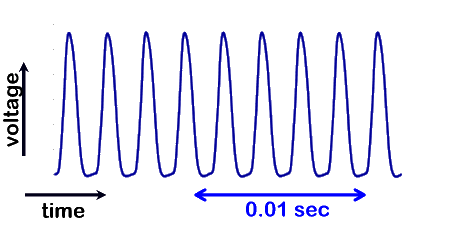
Apteronotid electric fish, like the overo knifefish, Adontosternarchus devenanzii,like the have high frequency EODs (500-2000 Hz). Apteronotid EODs are one of the fastest and most precise biological oscillations known. Notice how the waveform (or shape) of each discharge also differs between species.
 Electric Fish Lab